尤利乌斯 · 凯撒史诗时间轴海报
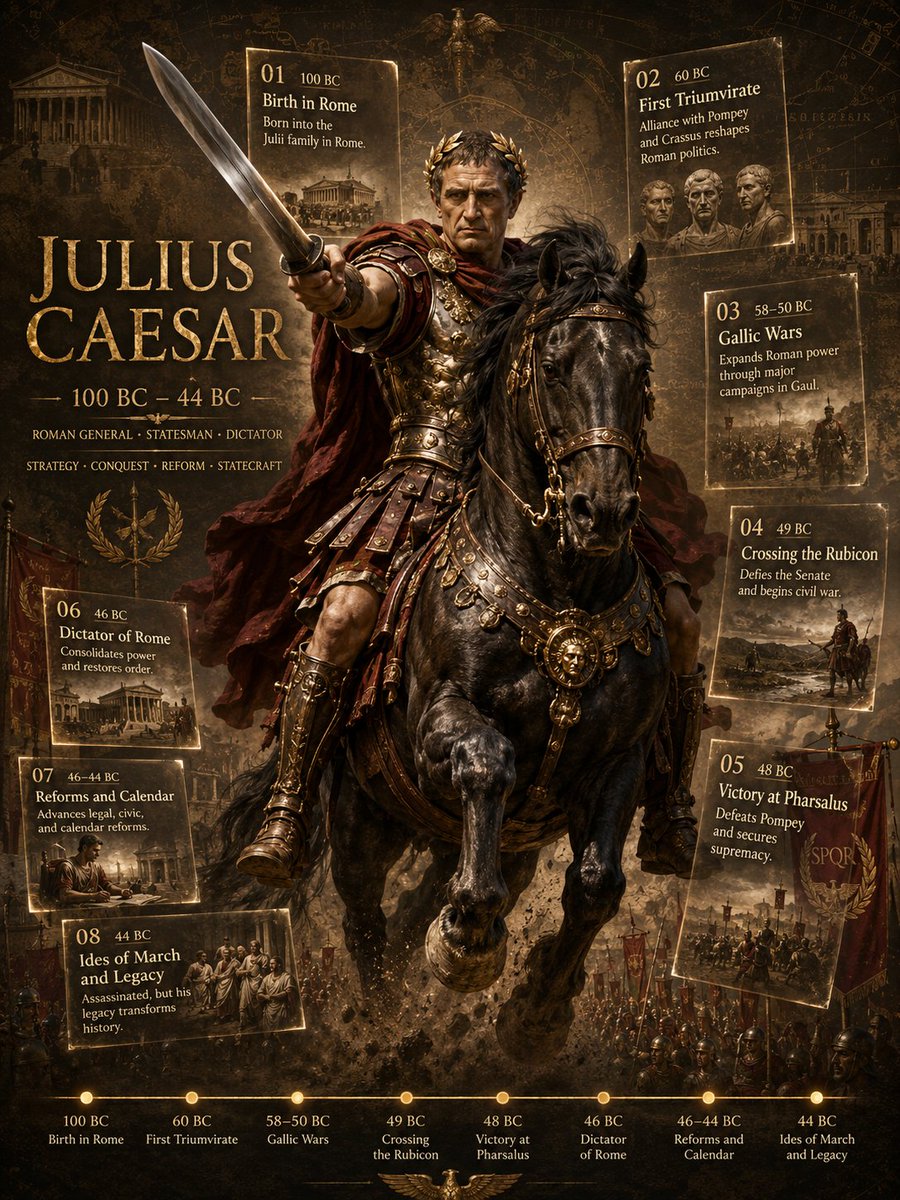
一张电影质感的古罗马传记海报,描绘了骑马的尤利乌斯 · 凯撒,配有八张历史事件卡片和底部时间轴。
- Category
- Charts & Infographics
- Model
- GPT Image 2
- Creator
- ai.gezgini
- Source language
- en
- Source ID
- 20399
- Published
- May 14, 2026
Full prompt
Goal: Create a dramatic cinematic historical biography poster for {argument name="subject figure" default="Julius Caesar"}, presenting him as a Roman general, statesman, and dictator in an epic ancient-war infographic style.

Canvas: Vertical 3:4 poster, dark sepia and black palette with antique gold typography, parchment textures, faint Roman maps, diagrams, constellations, and architectural sketches in the background. High-contrast lighting, smoky battlefield atmosphere, gritty dust, embers, and ornate metallic highlights.

Main subject: Center composition shows Julius Caesar riding a powerful black warhorse rearing forward. He wears elaborate Roman armor with gold details, leather skirt armor, bronze greaves, red cloak flowing behind him, and a laurel wreath. His right arm thrusts a short Roman sword toward the viewer in strong foreshortening. The horse has ornate gold-trimmed tack, medallions, leather straps, and dramatic glossy highlights. Keep the rider’s face intentionally obscured by a plain soft brown rectangular mask with no facial features. Behind him are Roman soldiers, standards, banners, and battlefield silhouettes.

Primary text: Large antique serif gold title on the left reads “{argument name="headline text" default="JULIUS CAESAR"}”. Under it place “100 BC – 44 BC”, then “ROMAN GENERAL · STATESMAN · DICTATOR”, then “STRATEGY · CONQUEST · REFORM · STATECRAFT”. Add a gold Roman eagle-and-laurel emblem below the text.

Event cards: Include exactly 8 glowing parchment-style historical event cards, numbered 01 through 08, each with a small sepia illustration and gold border. Arrange them around the central rider: two near the top, three down the right side, and three down the left/lower-left side. The 8 cards must read:
01 — “100 BC” — “Birth in Rome” — “Born into the Julii family in Rome.”
02 — “60 BC” — “First Triumvirate” — “Alliance with Pompey and Crassus reshapes Roman politics.”
03 — “58–50 BC” — “Gallic Wars” — “Expands Roman power through major campaigns in Gaul.”
04 — “49 BC” — “Crossing the Rubicon” — “Defies the Senate and begins civil war.”
05 — “48 BC” — “Victory at Pharsalus” — “Defeats Pompey and secures supremacy.”
06 — “46 BC” — “Dictator of Rome” — “Consolidates power and restores order.”
07 — “46–44 BC” — “Reforms and Calendar” — “Advances legal, civic, and calendar reforms.”
08 — “44 BC” — “Ides of March and Legacy” — “Assassinated, but his legacy transforms history.”

Bottom timeline: Add exactly 8 gold dots connected by a thin horizontal gold line along the bottom edge. Label them, from left to right: “100 BC Birth in Rome”, “60 BC First Triumvirate”, “58–50 BC Gallic Wars”, “49 BC Crossing the Rubicon”, “48 BC Victory at Pharsalus”, “46 BC Dictator of Rome”, “46–44 BC Reforms and Calendar”, “44 BC Ides of March and Legacy”.

Visual style: Hyper-detailed digital painting, epic historical fantasy realism, museum-quality military portrait, ornate Roman imperial design, dramatic chiaroscuro, gilded serif typography, aged manuscript overlays, cinematic poster lighting, sharp central figure, slightly hazy background. Use {argument name="accent color" default="antique gold"} for borders, text, timeline, and decorative symbols.

Constraints: Keep all text legible and correctly spelled. Use exactly 8 event cards and exactly 8 timeline points. Do not add modern objects, logos, watermarks, or extra people in the foreground beyond the mounted commander and background army. Maintain a dark ancient Roman atmosphere with no bright modern colors.
Translations
尤利乌斯 · 凯撒史诗时间轴海报
enGoal: Create a dramatic cinematic historical biography poster for {argument name="subject figure" default="Julius Caesar"}, presenting him as a Roman general, statesman, and dictator in an epic ancient-war infographic style. Canvas: Vertical 3:4 poster, dark sepia and black palette with antique gold typography, parchment textures, faint Roman maps, diagrams, constellations, and architectural sketches in the background. High-contrast lighting, smoky battlefield atmosphere, gritty dust, embers, and ornate metallic highlights. Main subject: Center composition shows Julius Caesar riding a powerful black warhorse rearing forward. He wears elaborate Roman armor with gold details, leather skirt armor, bronze greaves, red cloak flowing behind him, and a laurel wreath. His right arm thrusts a short Roman sword toward the viewer in strong foreshortening. The horse has ornate gold-trimmed tack, medallions, leather straps, and dramatic glossy highlights. Keep the rider’s face intentionally obscured by a plain soft brown rectangular mask with no facial features. Behind him are Roman soldiers, standards, banners, and battlefield silhouettes. Primary text: Large antique serif gold title on the left reads “{argument name="headline text" default="JULIUS CAESAR"}”. Under it place “100 BC – 44 BC”, then “ROMAN GENERAL · STATESMAN · DICTATOR”, then “STRATEGY · CONQUEST · REFORM · STATECRAFT”. Add a gold Roman eagle-and-laurel emblem below the text. Event cards: Include exactly 8 glowing parchment-style historical event cards, numbered 01 through 08, each with a small sepia illustration and gold border. Arrange them around the central rider: two near the top, three down the right side, and three down the left/lower-left side. The 8 cards must read: 01 — “100 BC” — “Birth in Rome” — “Born into the Julii family in Rome.” 02 — “60 BC” — “First Triumvirate” — “Alliance with Pompey and Crassus reshapes Roman politics.” 03 — “58–50 BC” — “Gallic Wars” — “Expands Roman power through major campaigns in Gaul.” 04 — “49 BC” — “Crossing the Rubicon” — “Defies the Senate and begins civil war.” 05 — “48 BC” — “Victory at Pharsalus” — “Defeats Pompey and secures supremacy.” 06 — “46 BC” — “Dictator of Rome” — “Consolidates power and restores order.” 07 — “46–44 BC” — “Reforms and Calendar” — “Advances legal, civic, and calendar reforms.” 08 — “44 BC” — “Ides of March and Legacy” — “Assassinated, but his legacy transforms history.” Bottom timeline: Add exactly 8 gold dots connected by a thin horizontal gold line along the bottom edge. Label them, from left to right: “100 BC Birth in Rome”, “60 BC First Triumvirate”, “58–50 BC Gallic Wars”, “49 BC Crossing the Rubicon”, “48 BC Victory at Pharsalus”, “46 BC Dictator of Rome”, “46–44 BC Reforms and Calendar”, “44 BC Ides of March and Legacy”. Visual style: Hyper-detailed digital painting, epic historical fantasy realism, museum-quality military portrait, ornate Roman imperial design, dramatic chiaroscuro, gilded serif typography, aged manuscript overlays, cinematic poster lighting, sharp central figure, slightly hazy background. Use {argument name="accent color" default="antique gold"} for borders, text, timeline, and decorative symbols. Constraints: Keep all text legible and correctly spelled. Use exactly 8 event cards and exactly 8 timeline points. Do not add modern objects, logos, watermarks, or extra people in the foreground beyond the mounted commander and background army. Maintain a dark ancient Roman atmosphere with no bright modern colors.
尤利乌斯 · 凯撒史诗时间轴海报
zh-CN目标:为 {argument name="subject figure" default="尤利乌斯 · 凯撒"} 创作一张极具戏剧性的电影质感历史传记海报,以史诗般的古代战争信息图风格,展现他作为罗马将军、政治家和独裁者的形象。 画布:垂直 3:4 海报,采用深棕褐色与黑色调,搭配古金色排版、羊皮纸纹理,背景融入模糊的罗马地图、图表、星座和建筑草图。高对比度光影,烟雾缭绕的战场氛围,粗砺的尘土、余烬以及华丽的金属高光。 主体:中心构图展示了尤利乌斯 · 凯撒骑着一匹强壮的黑色战马向前跃起。他身穿带有金色细节的精致罗马盔甲、皮革裙甲、青铜护胫,身后飘扬着红色斗篷,头戴月桂花环。他的右臂以强烈的透视感将一把罗马短剑指向观众。马匹配有华丽的镶金马具、勋章、皮带,并带有戏剧性的光泽高光。骑手的面部刻意用一个无五官的素色浅棕色矩形遮盖。他身后是罗马士兵、旗帜、横幅和战场剪影。 主要文字:左侧为巨大的古董衬线体金色标题,内容为“{argument name="headline text" default="JULIUS CAESAR"}”。下方依次排列“100 BC – 44 BC”、“ROMAN GENERAL · STATESMAN · DICTATOR”(罗马将军 · 政治家 · 独裁者)以及“STRATEGY · CONQUEST · REFORM · STATECRAFT”(战略 · 征服 · 改革 · 治国)。在文字下方添加一个金色的罗马鹰与月桂徽章。 事件卡片:包含 8 张发光的羊皮纸风格历史事件卡片,编号从 01 到 08,每张卡片配有小幅棕褐色插图和金色边框。将它们环绕在中心骑手周围:顶部两张,右侧三张,左侧/左下侧三张。8 张卡片内容如下: 01 — “100 BC” — “出生于罗马” — “出生于罗马尤利乌斯家族。” 02 — “60 BC” — “前三头同盟” — “与庞培和克拉苏结盟,重塑罗马政治。” 03 — “58–50 BC” — “高卢战争” — “通过在高卢的主要战役扩张罗马势力。” 04 — “49 BC” — “跨越卢比孔河” — “蔑视元老院,开启内战。” 05 — “48 BC” — “法萨卢斯战役胜利” — “击败庞培,确立统治地位。” 06 — “46 BC” — “罗马独裁官” — “巩固权力,恢复秩序。” 07 — “46–44 BC” — “改革与历法” — “推进法律、公民及历法改革。” 08 — “44 BC” — “三月十五日与遗产” — “遇刺身亡,但其遗产改变了历史。” 底部时间轴:在底部边缘添加 8 个由细横线连接的金色圆点。从左至右标注:“100 BC 出生于罗马”、“60 BC 前三头同盟”、“58–50 BC 高卢战争”、“49 BC 跨越卢比孔河”、“48 BC 法萨卢斯战役胜利”、“46 BC 罗马独裁官”、“46–44 BC 改革与历法”、“44 BC 三月十五日与遗产”。 视觉风格:超精细数字绘画,史诗历史奇幻写实主义,博物馆级军事肖像,华丽的罗马帝国设计,戏剧性的明暗对照法,镀金衬线排版,陈旧手稿叠加效果,电影海报光影,中心人物清晰,背景略显朦胧。边框、文字、时间轴和装饰符号使用 {argument name="accent color" default="古金色"}。 限制:确保所有文字清晰且拼写正确。使用 8 张事件卡片和 8 个时间轴点。除骑马指挥官和背景军队外,前景中不得添加现代物品、标志、水印或额外人物。保持深沉的古罗马氛围,禁止使用明亮的现代色彩。