Warm Schematic Design System 项目
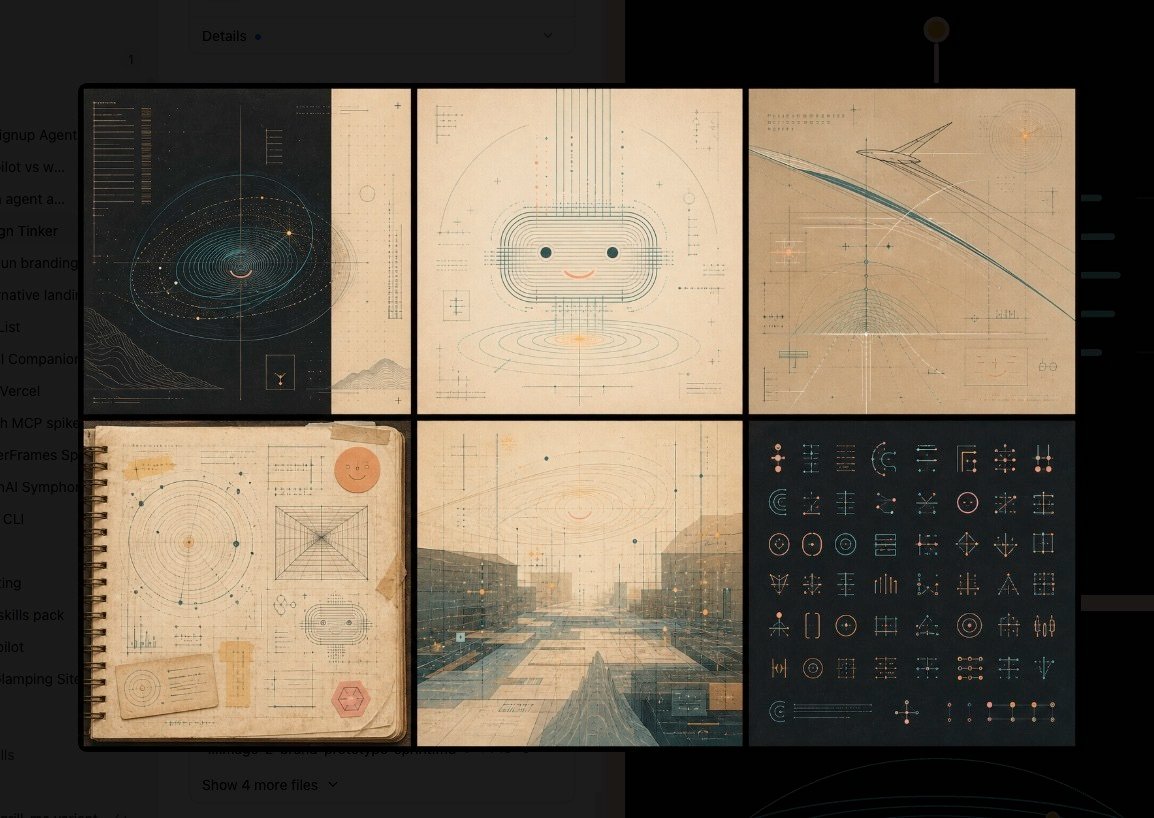
生成一个包含六个面板的暖色调技术情绪板,用于探索未来感 AI 界面设计系统。
- Category
- Charts & Infographics
- Model
- GPT Image 2
- Creator
- Philip Bankier
- Source language
- en
- Source ID
- 21108
- Published
- May 17, 2026
Full prompt
Goal: Create a warm, sophisticated schematic-aesthetic design systems mood board for {argument name="theme" default="friendly AI interface design"}, combining technical diagrams, vintage paper textures, and subtle futuristic UI symbols.

Canvas: Wide horizontal image, approximately 16:9, with a dark charcoal background and a centered 2-row by 3-column grid of six rectangular panels separated by thick black gutters. The overall mood is warm, archival, precise, and slightly mysterious, like a design-system exploration wall.

Layout: Use exactly 6 panels:
1. Top-left panel: dark navy/black technical blueprint with an orbital spiral or galaxy-like contour diagram, fine cyan linework, small glowing amber dots, vertical measuring lines, tiny unreadable annotations, and a small boxed icon near the bottom right.
2. Top-middle panel: cream paper schematic of a cute rounded robot face, made from layered rounded-rectangle contour lines, two teal dot eyes, a small peach smile, vertical and horizontal construction lines, small crosshair marks, and faint measurement notations.
3. Top-right panel: warm beige abstract architectural flight-path schematic with sweeping teal and gray arcs, angular line structures, fine grid lines, crosshairs, orange glow points, and tiny technical labels.
4. Bottom-left panel: aged spiral-bound notebook page with paper tape on the corners, circular radar charts, geometric construction diagrams, small UI glyphs, a peach smiley sticker in the upper right, a small card near the bottom left, and a red hexagonal stamp near the bottom right.
5. Bottom-middle panel: misty futuristic architectural landscape or plaza in muted teal and tan, overlaid with perspective grids, fine UI measurement lines, subtle orange highlights, and translucent schematic annotations.
6. Bottom-right panel: dark charcoal icon-system sheet containing exactly 54 small geometric UI glyphs arranged in a clean grid, using thin teal, peach, and beige lines; include circles, sliders, crosshairs, brackets, arrows, nodes, target symbols, grids, and abstract interface controls.

Visual style: Warm take on technical schematics; combine Bauhaus-like precision, mid-century information design, old engineering drawings, soft futuristic interface graphics, and tactile analog materials. Use muted colors: charcoal black, faded cream, parchment beige, dusty teal, pale cyan, peach, amber, and soft gray. Lines should be extremely fine and precise, with subtle glow only on small highlights. Add paper grain, scan texture, faint speckles, worn edges, and layered transparent drafting marks.

Text and marks: Include tiny pseudo-technical annotations and measurement ticks, but keep all text mostly illegible and decorative. Avoid large readable headlines. Use minimal symbols such as plus signs, crosshairs, coordinates, micro labels, and tiny rule marks.

Constraints: No people, no photorealistic objects except paper/notebook texture, no logos, no watermark, no extra panels beyond the 6 specified panels. Maintain a polished design-system exploration feel rather than a chaotic collage.
Translations
Warm Schematic Design System 项目
enGoal: Create a warm, sophisticated schematic-aesthetic design systems mood board for {argument name="theme" default="friendly AI interface design"}, combining technical diagrams, vintage paper textures, and subtle futuristic UI symbols. Canvas: Wide horizontal image, approximately 16:9, with a dark charcoal background and a centered 2-row by 3-column grid of six rectangular panels separated by thick black gutters. The overall mood is warm, archival, precise, and slightly mysterious, like a design-system exploration wall. Layout: Use exactly 6 panels: 1. Top-left panel: dark navy/black technical blueprint with an orbital spiral or galaxy-like contour diagram, fine cyan linework, small glowing amber dots, vertical measuring lines, tiny unreadable annotations, and a small boxed icon near the bottom right. 2. Top-middle panel: cream paper schematic of a cute rounded robot face, made from layered rounded-rectangle contour lines, two teal dot eyes, a small peach smile, vertical and horizontal construction lines, small crosshair marks, and faint measurement notations. 3. Top-right panel: warm beige abstract architectural flight-path schematic with sweeping teal and gray arcs, angular line structures, fine grid lines, crosshairs, orange glow points, and tiny technical labels. 4. Bottom-left panel: aged spiral-bound notebook page with paper tape on the corners, circular radar charts, geometric construction diagrams, small UI glyphs, a peach smiley sticker in the upper right, a small card near the bottom left, and a red hexagonal stamp near the bottom right. 5. Bottom-middle panel: misty futuristic architectural landscape or plaza in muted teal and tan, overlaid with perspective grids, fine UI measurement lines, subtle orange highlights, and translucent schematic annotations. 6. Bottom-right panel: dark charcoal icon-system sheet containing exactly 54 small geometric UI glyphs arranged in a clean grid, using thin teal, peach, and beige lines; include circles, sliders, crosshairs, brackets, arrows, nodes, target symbols, grids, and abstract interface controls. Visual style: Warm take on technical schematics; combine Bauhaus-like precision, mid-century information design, old engineering drawings, soft futuristic interface graphics, and tactile analog materials. Use muted colors: charcoal black, faded cream, parchment beige, dusty teal, pale cyan, peach, amber, and soft gray. Lines should be extremely fine and precise, with subtle glow only on small highlights. Add paper grain, scan texture, faint speckles, worn edges, and layered transparent drafting marks. Text and marks: Include tiny pseudo-technical annotations and measurement ticks, but keep all text mostly illegible and decorative. Avoid large readable headlines. Use minimal symbols such as plus signs, crosshairs, coordinates, micro labels, and tiny rule marks. Constraints: No people, no photorealistic objects except paper/notebook texture, no logos, no watermark, no extra panels beyond the 6 specified panels. Maintain a polished design-system exploration feel rather than a chaotic collage.
Warm Schematic Design System 项目
zh-CN目标:为 {argument name="theme" default="友好的 AI 界面设计"} 创建一个温暖、精致且具有示意图美感的设计系统情绪板,结合技术图表、复古纸张纹理和微妙的未来感 UI 符号。 画布:宽幅横向图像,比例约为 16:9,采用深炭灰色背景,中心放置一个 2 行 3 列的网格,包含六个由粗黑色间隙分隔的矩形面板。整体氛围温暖、具有档案感、精准且略带神秘,如同设计系统探索墙。 布局:使用 6 个面板: 1. 左上角面板:深海军蓝/黑色技术蓝图,带有轨道螺旋或类似星系的轮廓图、精细的青色线条、微小的琥珀色发光点、垂直测量线、细小的不可读注释,右下角附近有一个小方框图标。 2. 上方中间面板:奶油色纸张上的可爱圆润机器人脸示意图,由分层的圆角矩形轮廓线构成,带有两个青色圆点眼睛、一个小桃色微笑、垂直和水平构造线、小十字准线标记以及模糊的测量注释。 3. 右上角面板:暖米色抽象建筑飞行路径示意图,带有扫过的青色和灰色弧线、角形线条结构、精细网格线、十字准线、橙色发光点和微小的技术标签。 4. 左下角面板:带有纸胶带边角的陈旧螺旋装订笔记本页面,包含圆形雷达图、几何构造图、小型 UI 字形、右上角的桃色笑脸贴纸、左下角附近的一张小卡片,以及右下角附近的红色六边形印章。 5. 下方中间面板:柔和青色和棕褐色的朦胧未来感建筑景观或广场,叠加有透视网格、精细的 UI 测量线、微妙的橙色高光和半透明的示意图注释。 6. 右下角面板:深炭灰色图标系统表,包含整齐排列的 54 个小型几何 UI 字形,使用细青色、桃色和米色线条;包括圆圈、滑块、十字准线、括号、箭头、节点、目标符号、网格和抽象界面控件。 视觉风格:技术示意图的暖色调演绎;结合包豪斯式的精准、中世纪信息设计、旧工程图纸、柔和的未来感界面图形以及触感模拟材料。使用柔和的色彩:炭黑色、褪色的奶油色、羊皮纸米色、灰青色、淡青色、桃色、琥珀色和柔和的灰色。线条应极其精细且精准,仅在小高光处带有微妙的发光效果。添加纸张纹理、扫描质感、微弱斑点、磨损边缘和分层的透明绘图标记。 文字与标记:包含微小的伪技术注释和测量刻度,但保持所有文字基本不可读且具有装饰性。避免使用大的可读标题。使用最少的符号,如加号、十字准线、坐标、微型标签和微小的标尺标记。 约束:没有人像,除纸张/笔记本纹理外没有照片级真实物体,没有徽标,没有水印,除指定的 6 个面板外没有额外面板。保持精致的设计系统探索感,而非混乱的拼贴画。