中国木塔营造项目
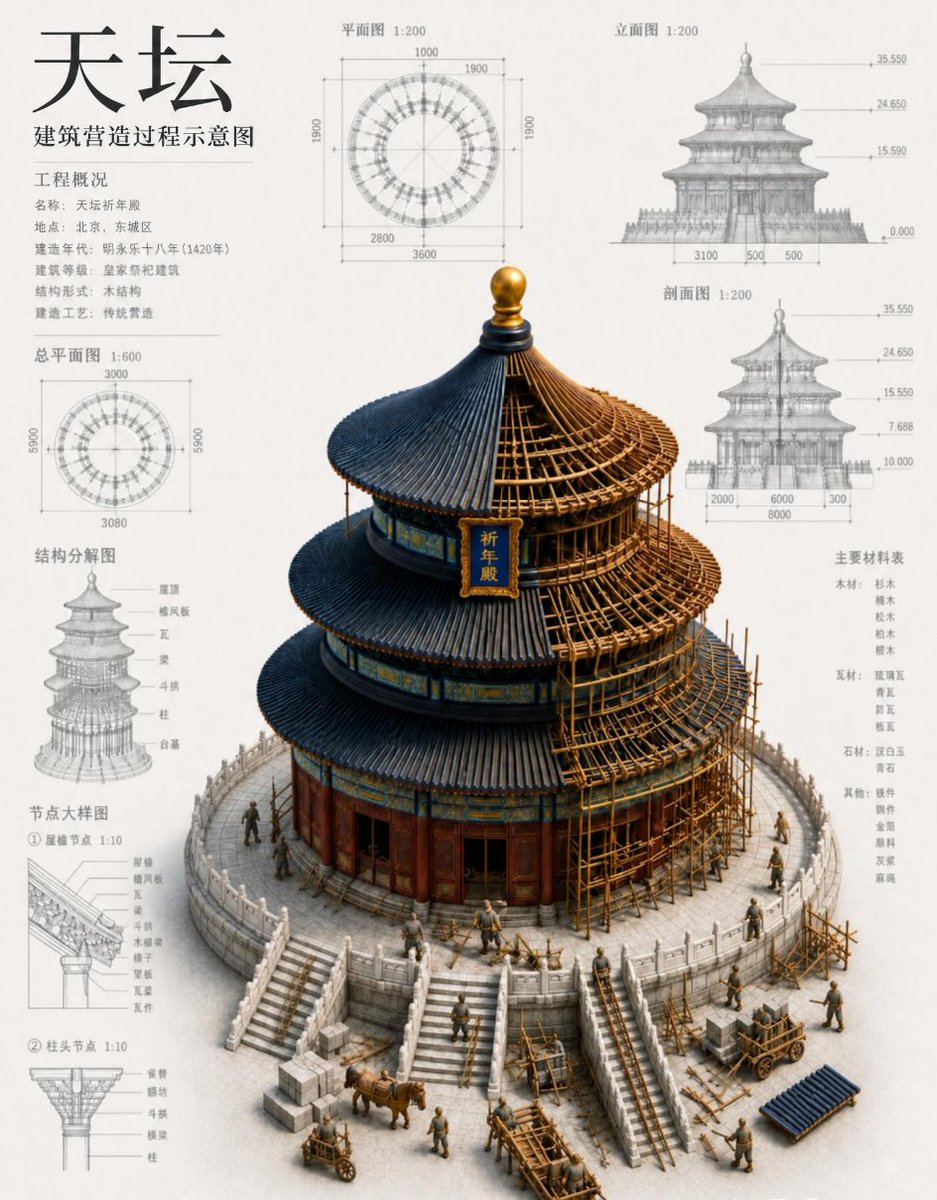
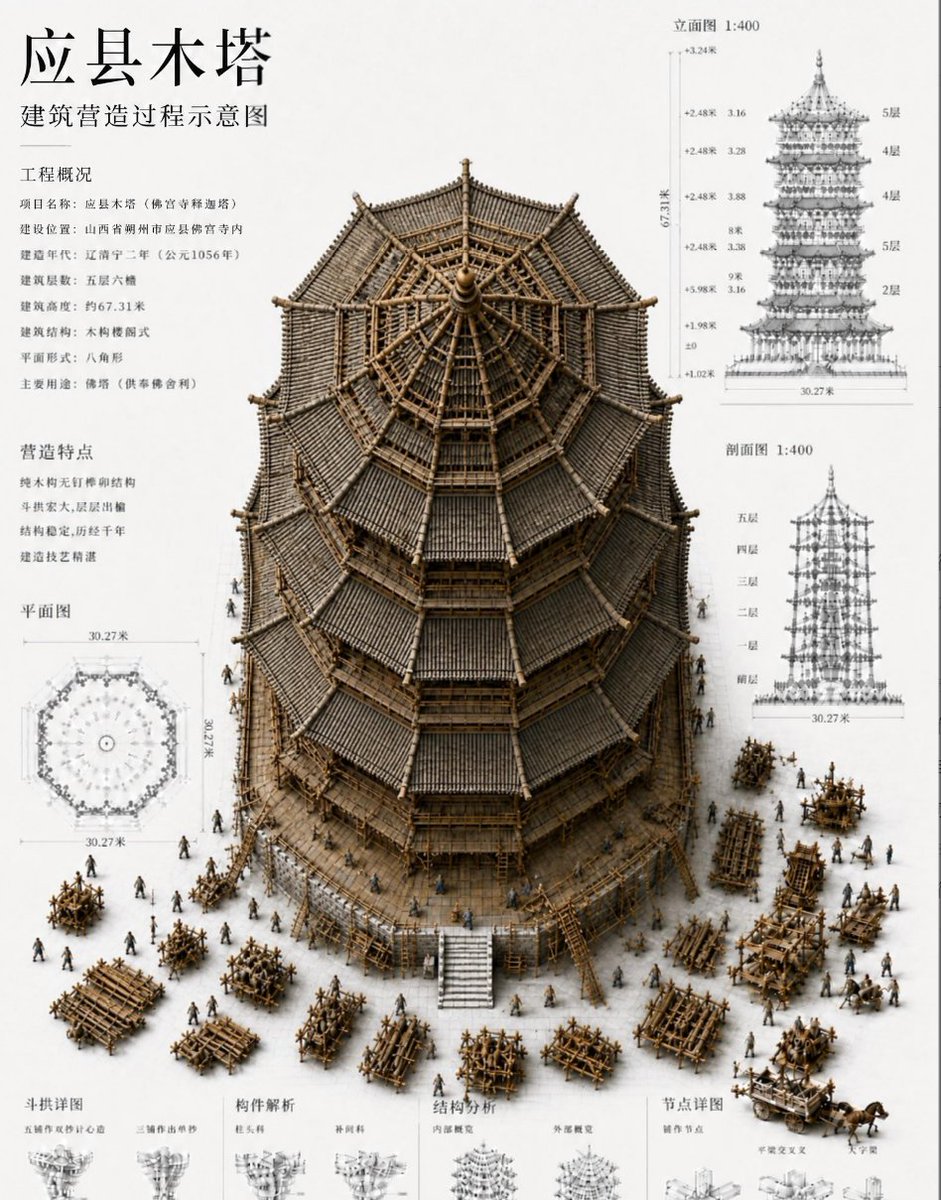
生成一张内容详实的中国建筑展示项目,通过图表、注释和中央 3D 模型,展示古代木塔的建造过程。
- Category
- Charts & Infographics
- Model
- GPT Image 2
- Creator
- 唐华斑竹🦅
- Source language
- en
- Source ID
- 22645
- Published
- May 25, 2026
Full prompt
Goal: Create a high-density architectural presentation board in Chinese showing the construction process diagram of an ancient wooden pagoda, centered on a realistic 3D cutaway/isometric model of {argument name="building name" default="应县木塔"} under construction.

Canvas: Portrait poster, off-white drafting-paper background, 4:5 ratio, clean museum-exhibition / architectural blueprint style. Use black Chinese typography, fine grey measurement lines, and sepia-brown timber materials. The image should feel like a technical architecture plate mixed with a miniature diorama.

Layout: Place a huge detailed octagonal timber pagoda model in the center, occupying most of the poster. Show the pagoda from a slightly elevated front angle so the roof structure and interior radial timber frame are visible. Surround the base with many tiny construction workers, scaffolds, timber piles, carts, ladders, cranes, and assembly frames. The surrounding drawings and text must stay aligned like a professional architectural sheet.

Text content: At top left, large title text: 「应县木塔」. Directly below, subtitle: 「建筑营造过程示意图」. Add two left-column information blocks titled 「工程概况」 and 「营造特点」 with multiple short Chinese lines describing project name, location, construction period, height, structure type, plan form, and craft characteristics. Keep the Chinese legible and not garbled.

Required diagram elements: Include exactly 7 major labeled diagram areas: 1) central 3D pagoda construction model, 2) left-column工程概况 text block, 3) left-column营造特点 text block, 4) lower-left 「平面图」 octagonal plan drawing with dimension marks around 30.27米, 5) upper-right 「立面图 1:400」 elevation drawing with floor labels and vertical dimensions, 6) mid-right 「剖面图 1:400」 section drawing with storey labels, 7) bottom strip of small technical detail panels labeled with categories such as 「斗拱详图」, 「构件解析」, 「结构分析」, and 「节点详图」.

Subject details: The pagoda should be an octagonal, multi-eaved Chinese timber tower with dark grey tiled roofs, exposed brown wooden beams, dense bracket sets, layered eaves, a central finial, and radial roof framing visible at the top. Add construction staging: unfinished upper interior trusses, scaffolding around lower levels, timber fences, and workers carrying beams. Use {argument name="primary material" default="wooden timber frame"} as the dominant construction material and {argument name="drawing scale" default="1:400"} for the elevation and section labels.

Visual style: Highly detailed architectural visualization, realistic miniature model rendering, precise technical annotation, fine ink lines, soft shadows, muted sepia and grey palette, no bright colors. Combine photorealistic 3D construction diorama with crisp 2D blueprint overlays. Make the typography resemble a formal Chinese architectural drawing sheet.

Constraints: Preserve the dense Chinese layout and technical drawing clarity. Do not add logos, watermarks, English labels, or modern buildings. Keep all diagrams spatially organized, with no overlapping text on the main pagoda. Ensure Chinese characters render correctly, especially the title {argument name="main title" default="应县木塔"} and subtitle {argument name="subtitle" default="建筑营造过程示意图"}.
Translations
中国木塔营造项目
enGoal: Create a high-density architectural presentation board in Chinese showing the construction process diagram of an ancient wooden pagoda, centered on a realistic 3D cutaway/isometric model of {argument name="building name" default="应县木塔"} under construction. Canvas: Portrait poster, off-white drafting-paper background, 4:5 ratio, clean museum-exhibition / architectural blueprint style. Use black Chinese typography, fine grey measurement lines, and sepia-brown timber materials. The image should feel like a technical architecture plate mixed with a miniature diorama. Layout: Place a huge detailed octagonal timber pagoda model in the center, occupying most of the poster. Show the pagoda from a slightly elevated front angle so the roof structure and interior radial timber frame are visible. Surround the base with many tiny construction workers, scaffolds, timber piles, carts, ladders, cranes, and assembly frames. The surrounding drawings and text must stay aligned like a professional architectural sheet. Text content: At top left, large title text: 「应县木塔」. Directly below, subtitle: 「建筑营造过程示意图」. Add two left-column information blocks titled 「工程概况」 and 「营造特点」 with multiple short Chinese lines describing project name, location, construction period, height, structure type, plan form, and craft characteristics. Keep the Chinese legible and not garbled. Required diagram elements: Include exactly 7 major labeled diagram areas: 1) central 3D pagoda construction model, 2) left-column工程概况 text block, 3) left-column营造特点 text block, 4) lower-left 「平面图」 octagonal plan drawing with dimension marks around 30.27米, 5) upper-right 「立面图 1:400」 elevation drawing with floor labels and vertical dimensions, 6) mid-right 「剖面图 1:400」 section drawing with storey labels, 7) bottom strip of small technical detail panels labeled with categories such as 「斗拱详图」, 「构件解析」, 「结构分析」, and 「节点详图」. Subject details: The pagoda should be an octagonal, multi-eaved Chinese timber tower with dark grey tiled roofs, exposed brown wooden beams, dense bracket sets, layered eaves, a central finial, and radial roof framing visible at the top. Add construction staging: unfinished upper interior trusses, scaffolding around lower levels, timber fences, and workers carrying beams. Use {argument name="primary material" default="wooden timber frame"} as the dominant construction material and {argument name="drawing scale" default="1:400"} for the elevation and section labels. Visual style: Highly detailed architectural visualization, realistic miniature model rendering, precise technical annotation, fine ink lines, soft shadows, muted sepia and grey palette, no bright colors. Combine photorealistic 3D construction diorama with crisp 2D blueprint overlays. Make the typography resemble a formal Chinese architectural drawing sheet. Constraints: Preserve the dense Chinese layout and technical drawing clarity. Do not add logos, watermarks, English labels, or modern buildings. Keep all diagrams spatially organized, with no overlapping text on the main pagoda. Ensure Chinese characters render correctly, especially the title {argument name="main title" default="应县木塔"} and subtitle {argument name="subtitle" default="建筑营造过程示意图"}.
中国木塔营造项目
zh-CN目标:创建一个高密度的中国建筑展示项目,展示古代木塔的建造过程示意图,中心为正在施工的 {argument name="building name" default="应县木塔"} 的逼真 3D 剖面/等轴测模型。 画布:纵向海报,米白色绘图纸背景,4:5 比例,简洁的博物馆展览/建筑蓝图风格。使用黑色中文字体、精细的灰色测量线和深褐色木材纹理。图像应呈现出技术建筑图板与微缩模型相结合的质感。 布局:在中心放置一个巨大的八角形木塔细节模型,占据海报大部分空间。从略微俯视的正面角度展示木塔,以便观察屋顶结构和内部放射状木框架。在底部周围布置许多微小的建筑工人、脚手架、木料堆、手推车、梯子、起重机和装配架。周围的图纸和文字必须像专业的建筑图纸一样保持对齐。 文字内容:左上角为大标题:「应县木塔」。下方为副标题:「建筑营造过程示意图」。在左侧添加两个信息块,标题分别为「工程概况」和「营造特点」,包含多行简短的中文,描述项目名称、地点、建造时期、高度、结构类型、平面形式和工艺特点。确保中文字符清晰,无乱码。 所需图表元素:包含 7 个主要的标注图区:1) 中央 3D 木塔施工模型,2) 左侧「工程概况」文字块,3) 左侧「营造特点」文字块,4) 左下角「平面图」八角形平面图,标注约 30.27 米的尺寸,5) 右上角「立面图 1:400」立面图,带有楼层标签和垂直尺寸,6) 右中「剖面图 1:400」剖面图,带有楼层标签,7) 底部一排小型技术细节面板,标注类别如「斗拱详图」、「构件解析」、「结构分析」和「节点详图」。 主体细节:木塔应为八角形多檐中国木塔,带有深灰色瓦顶、裸露的棕色木梁、密集的斗拱、层叠的屋檐、中央塔刹,顶部可见放射状屋顶框架。添加施工场景:未完成的上层内部桁架、下层周围的脚手架、木栅栏和搬运木梁的工人。使用 {argument name="primary material" default="木质框架"} 作为主要建筑材料,并使用 {argument name="drawing scale" default="1:400"} 作为立面图和剖面图的比例标签。 视觉风格:高度详细的建筑可视化,逼真的微缩模型渲染,精确的技术注释,精细的墨线,柔和的阴影,柔和的深褐色和灰色调,无鲜艳色彩。将照片级真实的 3D 施工模型与清晰的 2D 蓝图叠加结合。使排版类似于正式的中国建筑图纸。 约束:保持密集的中文布局和技术图纸的清晰度。不要添加徽标、水印、英文标签或现代建筑。保持所有图表在空间上井然有序,主木塔上不得有重叠文字。确保中文字符显示正确,特别是标题 {argument name="main title" default="应县木塔"} 和副标题 {argument name="subtitle" default="建筑营造过程示意图"}。