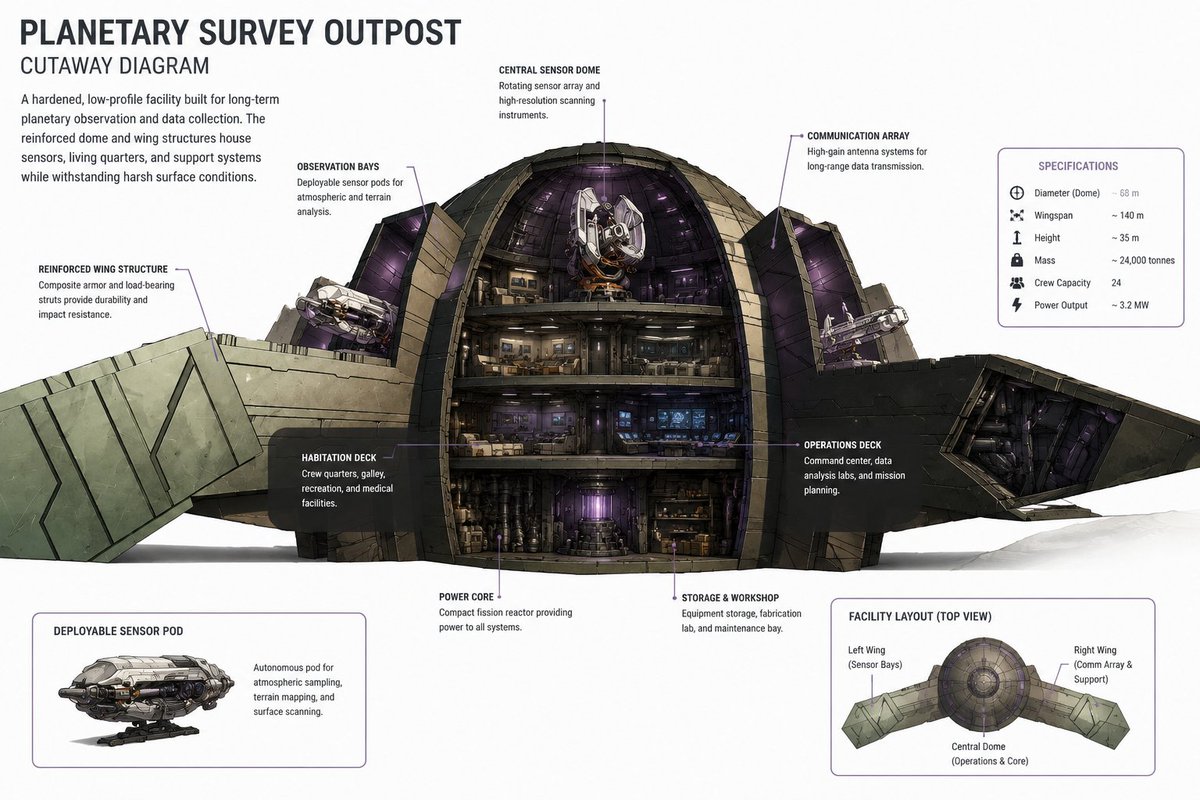
行星锚定站剖面图
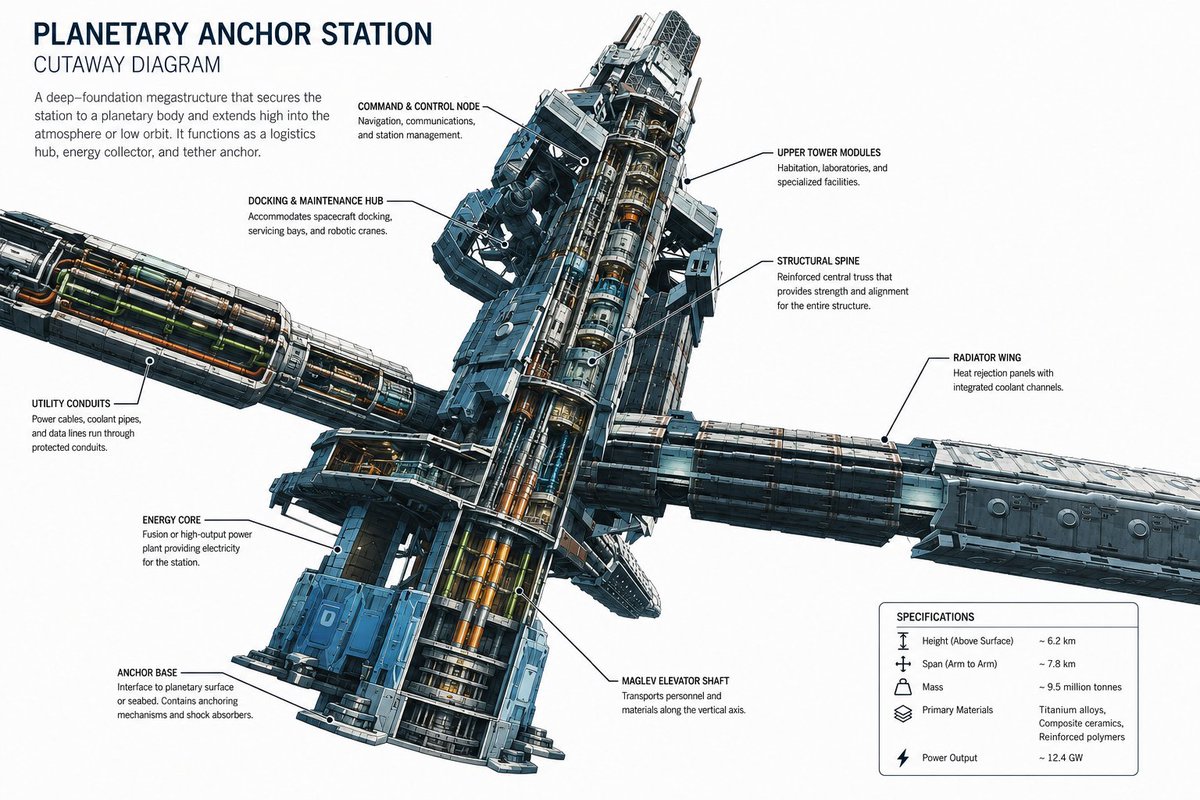
一张详尽的科幻工程海报,展示了用于世界观构建或游戏概念艺术的行星锚定巨型结构的标注剖面图。
- 分类
- 图表信息图
- 模型
- GPT Image 2
- 来源作者
- AshParker
- 原始语言
- en
- 来源 ID
- 20328
- 发布时间
- 2026年5月14日
完整提示词
目标:创作一张简洁的科幻技术剖面图,展示一个受《无人深空》(No Man's Sky)启发的巨型太空结构,标注为 {argument name="station name" default="行星锚定站"},精确呈现深地基轨道系留/物流枢纽的工业细节。

画布:宽幅 3:2 横向技术海报,白色背景,高分辨率,留有充足的标注空间。采用写实的硬表面概念艺术风格,配以清晰的黑色引导线、小型圆形标注点、纤细的技术字体以及结构下方的微妙阴影。

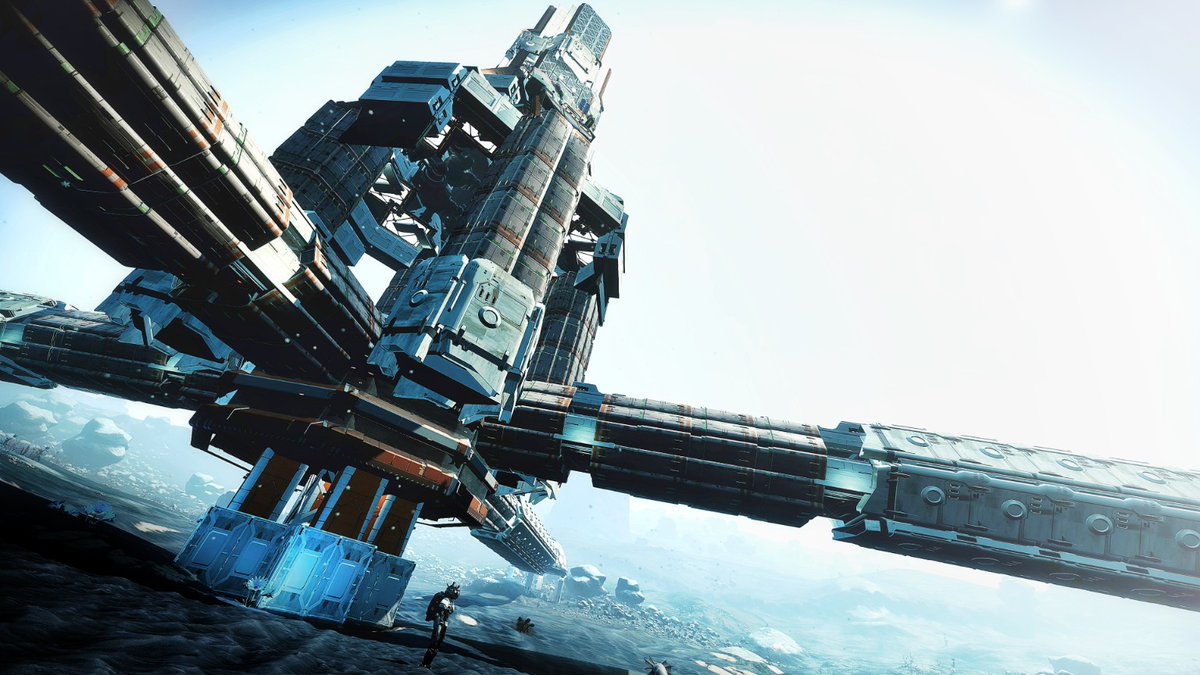
主体:一座巨大的垂直空间站横截面,从左下向右上倾斜,两条长长的水平臂从中央塔楼向左右延伸。结构呈蓝灰色、枪灰色、白色和深钢色,带有外露的铜色、橙色、绿色和黑色公用管道。中央塔楼部分被切开,露出堆叠的圆柱形机械、导管、电梯井、反应堆部分、服务甲板、桁架结构和发光的工业内部。左臂显示了分段导管外壳内许多外露的公用管道。右臂是一个更厚重的矩形散热器/电枢,带有面板镀层、圆形端口和机械接缝。下端有一个笨重的蓝色锚定底座,带有类似着陆脚的支撑和减震器细节。

左上角文字:大号粗体大写标题:{argument name="station name" default="行星锚定站"}。正下方为较小的副标题:{argument name="diagram subtitle" default="剖面图"}。在副标题下方,添加一段简短说明:{argument name="description text" default="一种将空间站固定在行星天体上并延伸至高层大气或低轨道的深地基巨型结构。它兼具物流枢纽、能量收集器和系留锚点的功能。"}

标注:包含 9 个带有引导线和圆点标记的标注,使用紧凑的大写标题,每项配有一句简短的解释性说明:1. 指挥与控制节点 — 导航、通信和空间站管理。2. 上层塔楼模块 — 居住区、实验室和专业设施。3. 对接与维护枢纽 — 用于航天器对接、维修舱和机器人起重机。4. 结构脊柱 — 加固的中央桁架,为整个结构提供强度和对齐支撑。5. 公用导管 — 电力电缆、冷却剂管道和数据线穿过受保护的导管。6. 散热翼 — 带有集成冷却通道的散热面板。7. 能源核心 — 为空间站提供电力的聚变或高输出发电厂。8. 锚定底座 — 与行星表面或海床的接口。包含锚定机构和减震器。9. 磁悬浮电梯井 — 沿垂直轴运送人员和物资。

规格框:在右下角放置一个带边框的白色方框,标题为“规格”。包含 5 行带有小型单色图标和数值的内容:高度(地表以上)— {argument name="station height" default="~ 6.2 公里"};跨度(臂展)— ~ 7.8 公里;质量 — ~ 950 万吨;主要材料 — 钛合金、复合陶瓷、增强聚合物;功率输出 — ~ 12.4 吉瓦。

视觉风格:未来派航空航天工程图,写实 3D 模型渲染与信息图表标注相结合,清晰的面板线条,外露的机械内部结构,真实的比例,无人像,无行星,无星空背景,无水印。保持背景为纯白色,字体清晰、黑色且易于阅读。
多语言版本
行星锚定站剖面图
enGoal: Create a clean sci-fi technical cutaway diagram of a massive No Man's Sky-inspired space megastructure labeled as {argument name="station name" default="PLANETARY ANCHOR STATION"}, showing a deep-foundation orbital tether/logistics hub in precise industrial detail. Canvas: Wide 3:2 landscape technical poster on a white background, high-resolution, with generous empty space for labels. Use a realistic hard-surface concept-art style with crisp black leader lines, small circular callout dots, thin technical typography, and subtle shadows under the structure. Main subject: A huge cross-sectioned vertical space station tilted diagonally from lower left to upper right, with two long horizontal arms extending left and right through the central tower. The structure is blue-gray, gunmetal, white, and dark steel, with exposed copper, orange, green, and black utility piping. The central tower is partially cut away to reveal stacked cylindrical machinery, conduits, elevator shafts, reactor sections, service decks, truss frames, and glowing industrial interiors. The left arm shows many exposed utility pipes inside segmented conduit housing. The right arm is a heavier rectangular radiator/armature with panel plating, circular ports, and mechanical seams. The lower end has a bulky blue anchor base with landing-foot-like supports and shock absorber details. Top-left text: Large bold uppercase title: {argument name="station name" default="PLANETARY ANCHOR STATION"}. Directly below it, smaller uppercase subtitle: {argument name="diagram subtitle" default="CUTAWAY DIAGRAM"}. Under the subtitle, add a short paragraph: {argument name="description text" default="A deep-foundation megastructure that secures the station to a planetary body and extends high into the atmosphere or low orbit. It functions as a logistics hub, energy collector, and tether anchor."} Callouts: Include exactly 9 labeled callouts with leader lines and small dot markers, using compact uppercase headings plus one short explanatory sentence each: 1. COMMAND & CONTROL NODE — Navigation, communications, and station management. 2. UPPER TOWER MODULES — Habitation, laboratories, and specialized facilities. 3. DOCKING & MAINTENANCE HUB — Accommodates spacecraft docking, servicing bays, and robotic cranes. 4. STRUCTURAL SPINE — Reinforced central truss that provides strength and alignment for the entire structure. 5. UTILITY CONDUITS — Power cables, coolant pipes, and data lines run through protected conduits. 6. RADIATOR WING — Heat rejection panels with integrated coolant channels. 7. ENERGY CORE — Fusion or high-output power plant providing electricity for the station. 8. ANCHOR BASE — Interface to planetary surface or seabed. Contains anchoring mechanisms and shock absorbers. 9. MAGLEV ELEVATOR SHAFT — Transports personnel and materials along the vertical axis. Specification box: Place a bordered white box in the lower-right corner titled SPECIFICATIONS. Include exactly 5 rows with small monochrome icons and values: Height (Above Surface) — {argument name="station height" default="~ 6.2 km"}; Span (Arm to Arm) — ~ 7.8 km; Mass — ~ 9.5 million tonnes; Primary Materials — Titanium alloys, Composite ceramics, Reinforced polymers; Power Output — ~ 12.4 GW. Visual style: Futuristic aerospace engineering diagram, photorealistic 3D model render mixed with infographic annotation, sharp panel lines, exposed mechanical innards, realistic scale, no people, no planets, no starfield, no watermark. Keep the background plain white and the typography clean, black, and highly legible.
行星锚定站剖面图
zh-CN目标:创作一张简洁的科幻技术剖面图,展示一个受《无人深空》(No Man's Sky)启发的巨型太空结构,标注为 {argument name="station name" default="行星锚定站"},精确呈现深地基轨道系留/物流枢纽的工业细节。 画布:宽幅 3:2 横向技术海报,白色背景,高分辨率,留有充足的标注空间。采用写实的硬表面概念艺术风格,配以清晰的黑色引导线、小型圆形标注点、纤细的技术字体以及结构下方的微妙阴影。 主体:一座巨大的垂直空间站横截面,从左下向右上倾斜,两条长长的水平臂从中央塔楼向左右延伸。结构呈蓝灰色、枪灰色、白色和深钢色,带有外露的铜色、橙色、绿色和黑色公用管道。中央塔楼部分被切开,露出堆叠的圆柱形机械、导管、电梯井、反应堆部分、服务甲板、桁架结构和发光的工业内部。左臂显示了分段导管外壳内许多外露的公用管道。右臂是一个更厚重的矩形散热器/电枢,带有面板镀层、圆形端口和机械接缝。下端有一个笨重的蓝色锚定底座,带有类似着陆脚的支撑和减震器细节。 左上角文字:大号粗体大写标题:{argument name="station name" default="行星锚定站"}。正下方为较小的副标题:{argument name="diagram subtitle" default="剖面图"}。在副标题下方,添加一段简短说明:{argument name="description text" default="一种将空间站固定在行星天体上并延伸至高层大气或低轨道的深地基巨型结构。它兼具物流枢纽、能量收集器和系留锚点的功能。"} 标注:包含 9 个带有引导线和圆点标记的标注,使用紧凑的大写标题,每项配有一句简短的解释性说明:1. 指挥与控制节点 — 导航、通信和空间站管理。2. 上层塔楼模块 — 居住区、实验室和专业设施。3. 对接与维护枢纽 — 用于航天器对接、维修舱和机器人起重机。4. 结构脊柱 — 加固的中央桁架,为整个结构提供强度和对齐支撑。5. 公用导管 — 电力电缆、冷却剂管道和数据线穿过受保护的导管。6. 散热翼 — 带有集成冷却通道的散热面板。7. 能源核心 — 为空间站提供电力的聚变或高输出发电厂。8. 锚定底座 — 与行星表面或海床的接口。包含锚定机构和减震器。9. 磁悬浮电梯井 — 沿垂直轴运送人员和物资。 规格框:在右下角放置一个带边框的白色方框,标题为“规格”。包含 5 行带有小型单色图标和数值的内容:高度(地表以上)— {argument name="station height" default="~ 6.2 公里"};跨度(臂展)— ~ 7.8 公里;质量 — ~ 950 万吨;主要材料 — 钛合金、复合陶瓷、增强聚合物;功率输出 — ~ 12.4 吉瓦。 视觉风格:未来派航空航天工程图,写实 3D 模型渲染与信息图表标注相结合,清晰的面板线条,外露的机械内部结构,真实的比例,无人像,无行星,无星空背景,无水印。保持背景为纯白色,字体清晰、黑色且易于阅读。