雨天动漫词汇表
为艺术家和提示词撰写者生成一份剪贴簿风格的日语信息图表,包含 24 个雨天动漫插画提示词。
- 分类
- 图表信息图
- 模型
- GPT Image 2
- 来源作者
- ぐふとくく
- 原始语言
- en
- 来源 ID
- 21960
- 发布时间
- 2026年5月21日
完整提示词
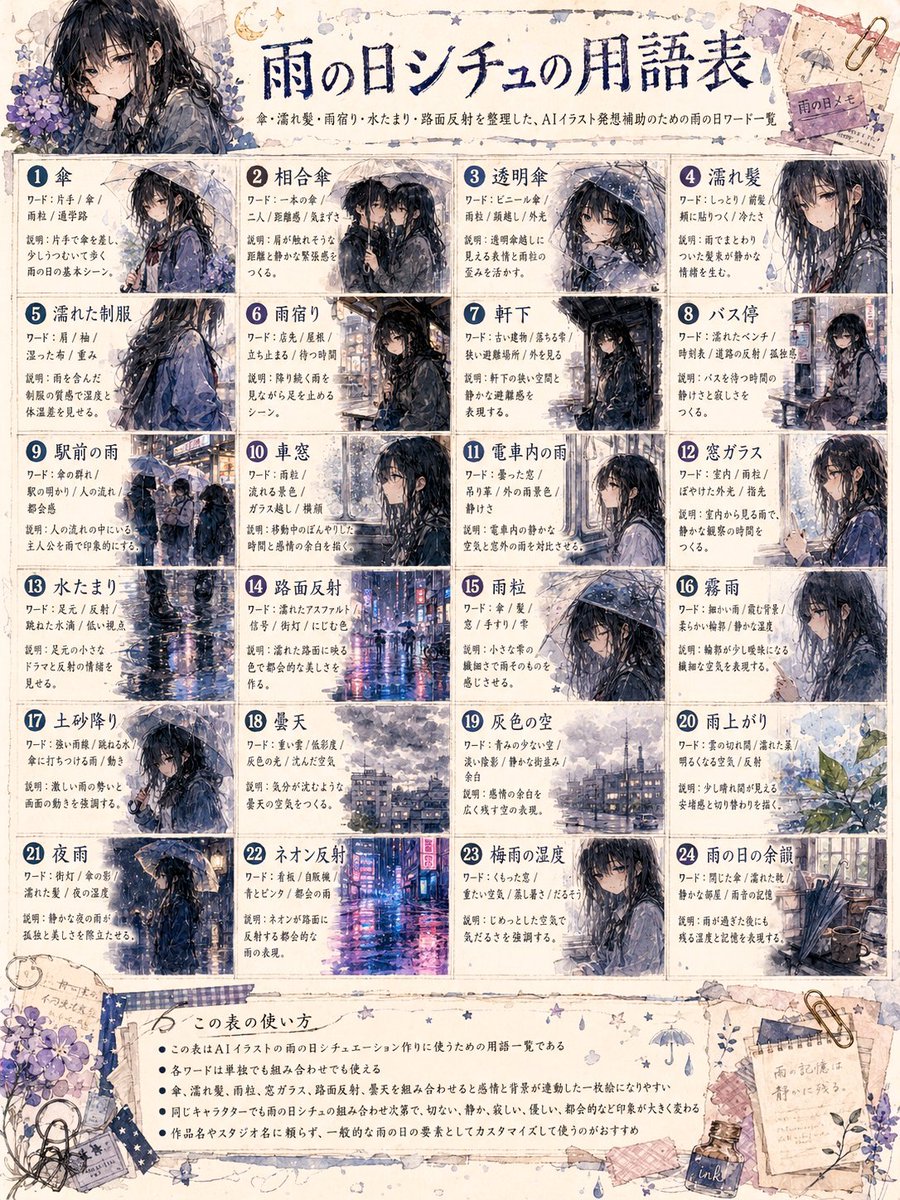
目标:创建一份详细的日式插画参考表信息图,标题为 {argument name="headline text" default="雨の日シチュの用語表"},解释用于 AI 插画提示词的实用雨天场景词汇。

画布:竖向 3:4 海报,带有墨迹的陈旧奶油色水彩纸,配有胶带、回形针、撕下的备忘录碎片、小星星、雨滴涂鸦、雨伞涂鸦以及角落里的紫色绣球花装饰。采用手工剪贴簿笔记本美学,配有细深蓝色分隔线和略显磨损的边缘。

整体视觉风格:柔和的动漫水彩和水墨画,忧郁的雨天氛围,采用柔和的深蓝色、灰色、薰衣草色和米色调。反复出现的主题是 {argument name="main character" default="一个穿着深色雨衣的黑发动漫女孩"},通常被雨淋湿,拿着或站在 {argument name="umbrella color" default="透明或黑色雨伞"} 下。添加反光的湿润街道、薄雾、水坑、玻璃上的雨滴以及模糊的城市灯光。保持文字密集但排列整齐,如同提示词编写速查表。

页眉:居中的大型日式毛笔书法标题,使用标题文本。下方添加一行较小的日语副标题,说明该表格整理了雨、雨季、水坑和道路反射等词汇,以支持 AI 插画提示词。在左上角放置一个带有绣球花的大型装饰性角色肖像;面部区域被柔和的方形模糊遮盖,与生成的视觉效果相匹配。在右上角添加贴好的小备忘录纸和装饰性雨伞草图。

主要布局:一个由 24 张编号词汇卡组成的网格,排列为 4 列 6 行。每张卡片都有一个深蓝色圆形数字徽章、一个粗体日语术语标题、两到三行简短的日语说明文字,以及一张小型动漫雨景缩略图。使用细深蓝色边框和米白色卡片背景。对 24 张卡片进行编号和标注,包含以下概念:1 雨伞,2 共用雨伞,3 透明雨伞,4 湿发,5 湿透的校服,6 雨中留宿或避雨,7 屋檐下,8 公交车站,9 车站前的雨,10 阵雨,11 火车车厢内的雨,12 窗户玻璃,13 水坑,14 路面反射,15 雨滴,16 细雨,17 泥泞的地面,18 多云的天空,19 灰色的天空,20 雨后,21 夜雨,22 霓虹灯反射,23 雨季的潮湿,24 雨后余韵。

缩略图细节:在保持相同雨天动漫氛围的同时,使每张卡片的图像各不相同。包括特写肖像、行走场景、雨伞、湿衣服、公交车站、车站人群、火车窗户、水坑反射、霓虹城市街道、雨后绣球花以及雨后的房间或小巷。第 10 张和第 11 张卡片应在角色面部区域的部分位置包含柔和的灰色方形模糊,呼应原始的遮盖效果。

底部区域:添加一个带有宽边框的注释面板,标题为日语的使用指南,包含 5 个简短的日语项目符号,解释如何将该词汇表用于 AI 插画提示词。底部装饰有和纸胶带、钢笔墨水瓶、散落的回形针、手写备忘录碎片、小花和微小的雨滴图标。

约束条件:最终图像必须呈现出信息密集的可打印参考表的感觉,而不是单幅插画。使用 24 张编号卡片和 5 个底部项目符号。保持日式书法标题突出,维持清晰的网格结构,并避免添加任何徽标或水印。
多语言版本
雨天动漫词汇表
enGoal: Create a detailed Japanese-style illustrated reference sheet infographic titled {argument name="headline text" default="雨の日シチュの用語表"}, explaining useful rainy-day scene vocabulary for AI illustration prompts. Canvas: Portrait 3:4 poster, aged cream watercolor paper with ink stains, tape, paperclips, torn memo scraps, tiny stars, raindrop doodles, umbrella doodles, and purple hydrangea decorations in the corners. Use a handmade scrapbook notebook aesthetic with thin navy divider lines and slightly worn edges. Overall visual style: Soft anime watercolor and ink wash, melancholic rainy atmosphere, muted navy, gray, lavender, and beige palette. The recurring subject is {argument name="main character" default="a black-haired anime girl in a dark raincoat"}, usually wet from rain, carrying or standing under {argument name="umbrella color" default="a transparent or black umbrella"}. Add reflective wet streets, mist, puddles, raindrops on glass, and blurred city lights. Keep the text dense but neatly organized like a prompt-writing cheat sheet. Header: Large centered brush-calligraphy Japanese headline using the headline text. Under it, add a smaller Japanese subtitle line explaining that the sheet organizes rain, rainy season, puddles, and road-reflection words for AI illustration prompt support. Place a large decorative character portrait at the upper left with hydrangeas; the face area is covered by a soft square blur, matching the generated look. At the upper right, add small taped memo papers and a decorative umbrella sketch. Main layout: A grid of exactly 24 numbered vocabulary cards, arranged 4 columns by 6 rows. Each card has a dark blue circular number badge, a bold Japanese term title, two or three short Japanese explanatory text lines, and a small anime rainy-scene thumbnail. Use thin navy borders and off-white card backgrounds. Count and label the 24 cards as follows, with these visible concepts: 1 umbrella, 2 shared umbrella, 3 transparent umbrella, 4 wet hair, 5 wet school uniform, 6 rain lodging or taking shelter from rain, 7 under the eaves, 8 bus stop, 9 rain in front of the station, 10 sudden shower, 11 rain inside a train car, 12 window glass, 13 puddle, 14 road surface reflection, 15 raindrops, 16 misty rain, 17 muddy ground, 18 cloudy sky, 19 gray sky, 20 after the rain, 21 night rain, 22 neon reflections, 23 rainy-season humidity, 24 rainy-day aftermath. Thumbnail details: Vary every card image while keeping the same rainy anime mood. Include close-up portraits, walking scenes, umbrellas, wet clothes, bus stop, station crowd, train window, puddle reflection, neon city street, hydrangea after rain, and rainy room or alley aftermath. Cards 10 and 11 should include soft gray square blurs over part of the character face area, echoing the original censored-looking artifacts. Bottom section: Add a wide bordered note panel titled in Japanese as a usage guide, with exactly 5 bullet points in small Japanese text explaining how to use the vocabulary list for AI illustration prompts. Decorate the bottom with washi tape, a fountain pen ink bottle, scattered clips, handwritten memo scraps, small flowers, and tiny rain icons. Constraints: The final image must feel like an information-dense printable reference sheet, not a single illustration. Use exactly 24 numbered cards and exactly 5 bottom bullet points. Keep the Japanese calligraphy headline prominent, maintain legible grid structure, and avoid adding logos or watermarks.
雨天动漫词汇表
zh-CN目标:创建一份详细的日式插画参考表信息图,标题为 {argument name="headline text" default="雨の日シチュの用語表"},解释用于 AI 插画提示词的实用雨天场景词汇。 画布:竖向 3:4 海报,带有墨迹的陈旧奶油色水彩纸,配有胶带、回形针、撕下的备忘录碎片、小星星、雨滴涂鸦、雨伞涂鸦以及角落里的紫色绣球花装饰。采用手工剪贴簿笔记本美学,配有细深蓝色分隔线和略显磨损的边缘。 整体视觉风格:柔和的动漫水彩和水墨画,忧郁的雨天氛围,采用柔和的深蓝色、灰色、薰衣草色和米色调。反复出现的主题是 {argument name="main character" default="一个穿着深色雨衣的黑发动漫女孩"},通常被雨淋湿,拿着或站在 {argument name="umbrella color" default="透明或黑色雨伞"} 下。添加反光的湿润街道、薄雾、水坑、玻璃上的雨滴以及模糊的城市灯光。保持文字密集但排列整齐,如同提示词编写速查表。 页眉:居中的大型日式毛笔书法标题,使用标题文本。下方添加一行较小的日语副标题,说明该表格整理了雨、雨季、水坑和道路反射等词汇,以支持 AI 插画提示词。在左上角放置一个带有绣球花的大型装饰性角色肖像;面部区域被柔和的方形模糊遮盖,与生成的视觉效果相匹配。在右上角添加贴好的小备忘录纸和装饰性雨伞草图。 主要布局:一个由 24 张编号词汇卡组成的网格,排列为 4 列 6 行。每张卡片都有一个深蓝色圆形数字徽章、一个粗体日语术语标题、两到三行简短的日语说明文字,以及一张小型动漫雨景缩略图。使用细深蓝色边框和米白色卡片背景。对 24 张卡片进行编号和标注,包含以下概念:1 雨伞,2 共用雨伞,3 透明雨伞,4 湿发,5 湿透的校服,6 雨中留宿或避雨,7 屋檐下,8 公交车站,9 车站前的雨,10 阵雨,11 火车车厢内的雨,12 窗户玻璃,13 水坑,14 路面反射,15 雨滴,16 细雨,17 泥泞的地面,18 多云的天空,19 灰色的天空,20 雨后,21 夜雨,22 霓虹灯反射,23 雨季的潮湿,24 雨后余韵。 缩略图细节:在保持相同雨天动漫氛围的同时,使每张卡片的图像各不相同。包括特写肖像、行走场景、雨伞、湿衣服、公交车站、车站人群、火车窗户、水坑反射、霓虹城市街道、雨后绣球花以及雨后的房间或小巷。第 10 张和第 11 张卡片应在角色面部区域的部分位置包含柔和的灰色方形模糊,呼应原始的遮盖效果。 底部区域:添加一个带有宽边框的注释面板,标题为日语的使用指南,包含 5 个简短的日语项目符号,解释如何将该词汇表用于 AI 插画提示词。底部装饰有和纸胶带、钢笔墨水瓶、散落的回形针、手写备忘录碎片、小花和微小的雨滴图标。 约束条件:最终图像必须呈现出信息密集的可打印参考表的感觉,而不是单幅插画。使用 24 张编号卡片和 5 个底部项目符号。保持日式书法标题突出,维持清晰的网格结构,并避免添加任何徽标或水印。